

Water Rebozo
A restaurative practice calling for belonging
If you’d like to train with us, you can come and meet us in person or purchase our online self-study course. We offer a range of training programmes designed for everyone, from introductory workshops to specialised courses for those who already have some prior knowledge of aquatic therapy.
NEXT COURSES: Introduction to Land & Water Rebozo, 13h
We will explore on land and in water how fabrics act as an extension of the hands and the embrace, composing a conscious therapeutic gesture that supports individual processes and bodywork in general, always respecting the timing and intelligence of each body. Open to all interested participants with body consciousness and understanding background.
8-10. October
Líquidzome | Sintra, Portugal | (PT & ENG)
7-8. November
Ile de Ré, France | (FR & ENG)
For other dates in 2027, please see Agenda.
Read more about Water Rebozo here.
Si vous souhaitez suivre une formation chez nous, vous pouvez soit venir nous rencontrer en personne (consultez notre programme 2026), soit acheter notre formation en ligne, conçue pour les personnes ayant déjà une expérience dans le domaine aquatique.
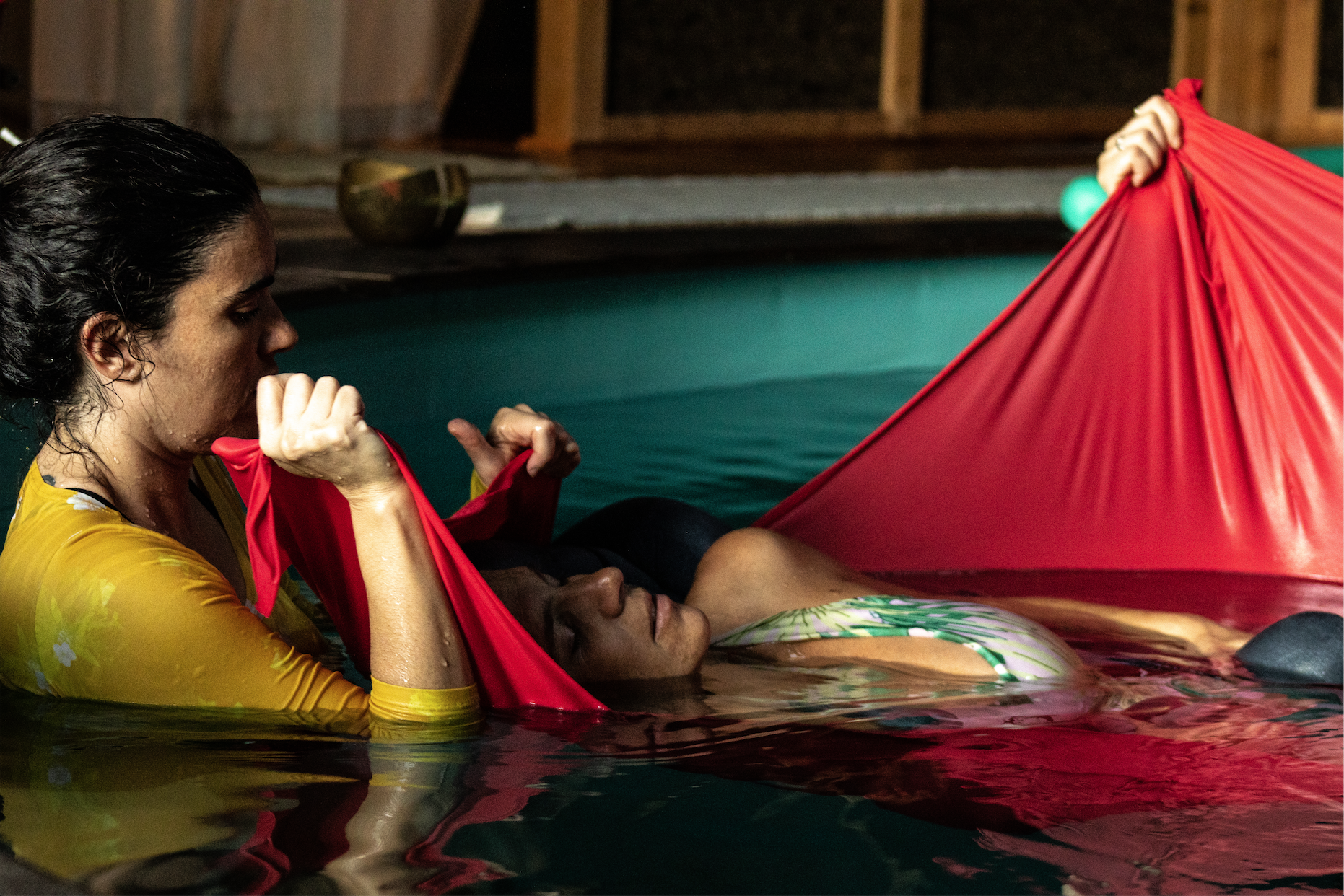
Water Rebozo, a somatic practice
The Water Rebozo is an aquatic practice with fabrics that we have been exploring and developing for about ten years, and people often ask how it started. It was an answer to a need to offer, and to feel, more containment in the water, together with our own drive for creativity.
The fabric as container or a layer
Bringing fabric into the water lets us define a comfort zone, it reduces the space, creating a membrane around the person receiving, unifies the body, and concentrates attention and the energetic field. Theodor Schwenk, in his studies of water's living movement, showed that water never holds a fixed shape, it is constantly organizing itself into flowing, vortical forms in response to whatever contains or moves it, and the rebozo gives support of the principle to be seen and embodied. It becomes a boundary that water can move around and through, creating border that is felt rather than fixed, replacing muscular containment with relational containment, a safe edge that lets a person release without fully losing their spatial orientation.
A tool for nervous system regulation
Over years of working across different settings and different people, in water and on land, we came to understand the Water Rebozo as a tool for profound neural regulation. In water, gravity stops being a force to resist, it is redistributed, and the body's weight becomes an experience of support without struggle, in contrast to land, where weight is so often synonymous with effort and threat.
This is close to what Peter Levine calls titration, small movements, safely increasing the sensation that lets the nervous system discharge and reorganize without being overwhelmed. The aquatic environment supports something similar on its own, it eases nociceptive load, and, in line with polyvagal theory, the felt sense of safety it offers may support a more ventral vagal, socially engaged state, less vigilance, increasing a person's tolerance of being held and lowering the fear of surrender. The water and the rebozo touch relax a person in the moment of the action itself. The message that takes root is simple, “I can let myself go, or lose my balance, without falling apart.”
The wrapping phase is also thought to stimulate the vagus nerve and the parasympathetic system, slowing the heart rate and the breath, and everything slows down. For some people, that much stillness can conflict into something closer to a feeling of losing or disappearing, and a wide range of sensations and thoughts can surface, and we hold space for that too. Part of what makes this work possible is co-regulation, the practitioner's own embodied calm, the doula's capacity to pause, to read the moment, and to improvise rather than follow a fixed script, transmitted through presence and touch, offers the nervous system something to entrain to before it has to find stillness alone. The engagement of the practitionis essential, core of the Water Doula experience.
We carry this sense of security gained in water to the land, and from the land back to the water, this becomes an imprint that stays beyond the session.
Land & water
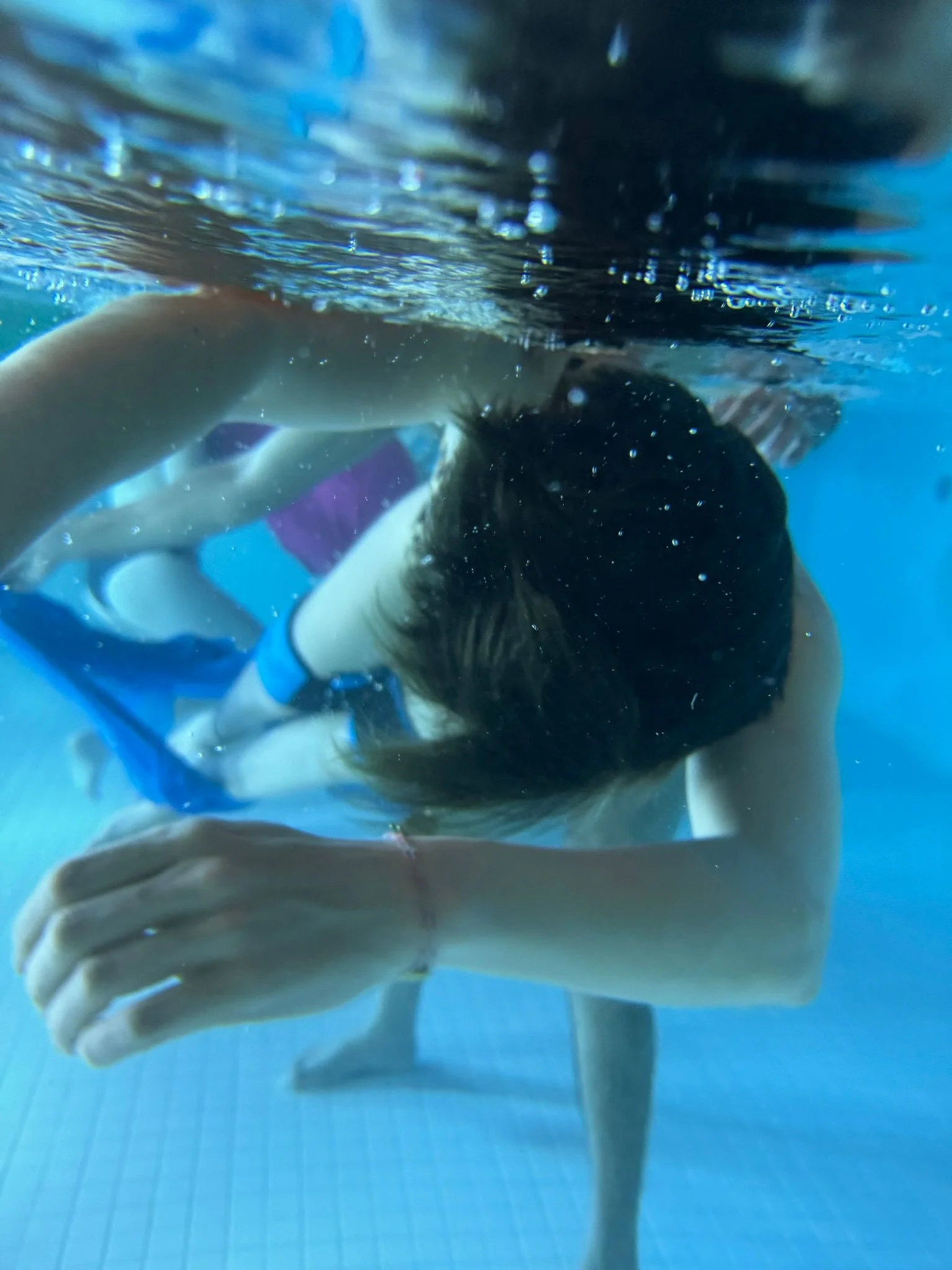
In our practice, water is always present, even when we work on land, the fabrics and the cradling technique carry a water based sensibility with them wherever we go. Much of what we offer is organized around negotiating weight and direction with the person being supported, facilitating safe immersions or micro falls, and preparing the body for unpredictability, while cultivating attention, readiness, relaxation, and surrender.
In water, we constantly attune to the body's floating axis through slow movements, glides, moments of releasing and regaining weight within the fabric, shifting between support, containment, and free floating. On land, the challenge changes, and it becomes about tolerating the body's full weight and trusting gravity during handling. We work with this through rhythmic movement, sustained positions, long pauses, and close listening to each person's inner rhythm. Landl and water are complementary, each preparing the ground for the other.
In water specifically, we reduce visual vigilance, the fabric sets a boundary without intruding, and movement that is suggested rather than imposed restores autonomy to the person receiving care. The fabric is meeting the body in parts, and also as a whole, creating a continuum, so the nervous system can settle without depending on touch alone. This builds a genuine bodily impression, a kind of safety memory, a reminder that the body has been supported before, and for many people, this evokes memories of pregnancy and of childhood, or meets a lack for that kind of holding.
For practitioners who work across both elements, this builds a deeper, more embodied fluency/fluidity in the techniques themselves, and for those receiving care, it builds a greater capacity to let go, reinforcing the idea that it's possible to sustain intensity while still reorganizing, without needing to shut down.
Honoring our lineages
We didn't invent this from nothing. In total reverence to traditional midwifery and birth keepers, we have kept the name rebozo in their honor, a shawl used for generations across Mexican culture to support a mother's physical, emotional, and spiritual healing, a lineage midwives like Naolí Vinaver continue to carry and teach today. Our own path through water also has much to thank Harold Dull for, whose development of Watsu opened the aquatic bodywork field this practice grows from, showing that touch, support, and stillness could move as fluidly as the water itself.
As Michel Odent wrote in his 1983 article “Birth Under Water,” inside water the reduction of sensory stimulation, the reduced effect of gravity, and the shift in nervous conduction and peripheral vascular activity can help women even in the first stage of labour. Sometimes the mere sight of water, and the sound of it filling the pool, is enough to release inhibition and reach the state of consciousness birth asks for. The rebozo works the same way, in labour we so often need points of support and security, and the fabric's interface can help a body cope with contractions, welcoming it back into relaxation between the waves of the birth journey, and the Water Rebozo brings this same intention into aquatic experiences in a wider sense.
We believe that in water we can create safety, allowing bodies and stories to unfold.
Come to experience this practice with us, explore the collective ceremonies, the couple journey’s, our workshops and courses link agenda.

Dull, H. (2008). Watsu: Freeing the Body in Water (4th ed.). Watsu Publishing.
Levine, P. A. (1997). Waking the Tiger: Healing Trauma. North Atlantic Books.
Odent, M. (1983). Birth under water. The Lancet, 322(8365–8366), 1476–1477.
Schwenk, T. (1965). Sensitive Chaos: The Creation of Flowing Forms in Water and Air (J. Collis, Trans.). Rudolf Steiner Press.
Vinaver López, N. (n.d.). Rebozo para o parto: Compêndio de técnicas aplicadas na gestação, trabalho de parto, parto e pós-parto (G. Sánchez Sosa, Ill.). La Hoja en Blanco Ediciones.
Online self-guided program
Online self-guided program

Available in english and in french
